SUMMARY
Selected Data from Form ETA 581
Quarter Ending December 31, 2002
Subject Employers - Nationally
| Contributory Employers | 6,910,058 * |
| Reimbursing Employers | 98,108 ** |
| Total All Employers | 7,008,166 |
| Determinations | Completed 90 Days or Less |
Completed 180 Days or Less |
|
|---|---|---|---|
| New Employers | 195,317 | 83.9% | 91.2% |
| Successor Employers | 25,732 | 64.4% | 77.3% |
| % Filed Timely | % Secured | % Resolved | |
|---|---|---|---|
| Contributory Employers | 88.4% | 92.4% | 96.4% |
| Reimbursing Employers | 89.1% | 93.4% | 93.9% |
| Beginning Balance | 642.3 million | New Receivables | 448.6 million |
| Amount Liquidated | 346.7 million | Declared Uncollectable | 13.6 million |
| Removed Due to Age | 66.7 million | Ending Balance | 663.9 million |
| Audits Completed | 26,108 | Average Hrs. Per Audit | 7.4 hours |
| Large Employer Audits | 696 | Average Qtrs. Audited | 4.6 quarters |
| Change Audits | 11,235 | ||
| Total Wages Under Reported |
436.3 million | Contributions Under Reported |
6.7 million |
| Total Wages Over Reported |
- 551.5 million *** | Contributions Over Reported |
- 1.0 million |
| Approximate Net Change | - 115.2 million *** | Approximate Net Change | + 5.7 million |
| Number of employees misclassified as independent contractors: | 30,135 | ||
|
|||
| * Total adjusted to include an estimate of 5,000 contributing employers for VI | |||
| ** Total adjusted to include an estimate of 100 reimbursable employers for VI | |||
| *** One Ohio audit resulted in a Total Wage adjustment of $459,271,195 due to erroneous data in their wage record system. | |||
Selected Data from Form ETA 581
Quarter Ending December 31, 2002
Subject Employers
As of December 31, 2002, the number of employers subject to state unemployment compensation laws rose to 7,008,166, an increase of 53,668 over the previous quarter ending September 30, 2002, and an increase of 81,719 over the total reported one year ago for the quarter ending December 31, 2001. For the Virgin Islands these totals include an estimate of 3,600 employers for the quarter ending December 31, 2001, and an adjusted estimate of 5,100 employers for the quarter ending December 31, 2002.
During the months of October, November and December 2002, states reported either terminating or inactivating 196,267 accounts. This is a decrease of 40,501 from the quarter ending June 30, 2002, and an increase of 5,841 compared to the quarter ending December 31, 2001.
Status Determination Promptness
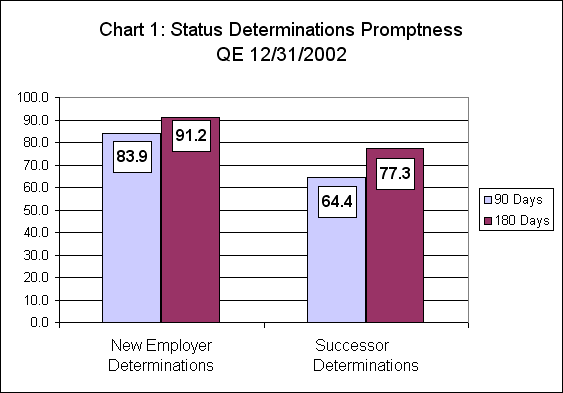
Status determinations establishing liability for new employers totaled 195,317, of which 83.9% were completed within 90 days or less from the end of the quarter in which the employer met a liability threshold. The promptness percentage increased to 91.2% for the 180 day timeframe. All states made as least 60% of their status determinations on new employers within 90 days. Only two states failed to meet the 80% objective within 180 days. Percentages for the 180-day measure ranged from a low of 77.7% to a high of 97.6%.
Successorship determinations for the quarter totaled 25,732. This is a decline of 7,557 determinations from the 33,289 reported for the quarter ending September 30, 2002. States averaged completing 64.4% of successor determinations within 90 days. Performance improved for the 90-day timeframe (up 4.4%) but declined for the 180-day measure (down 4.1%) when compared to the quarter ending September 30, 2002.
See Table 1, Status Determination Promptness.
Filing Reports - Contributory and Reimbursing Employers
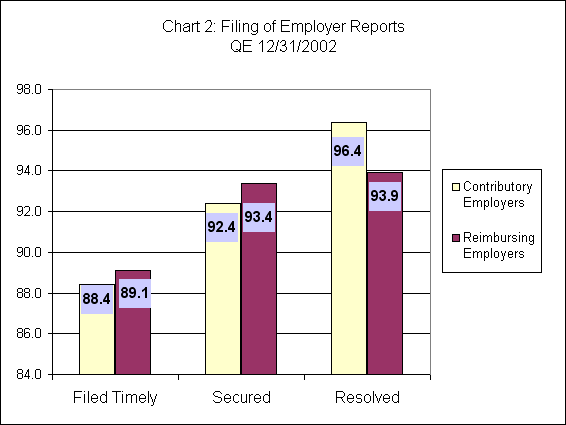
The 52 reporting states anticipated receiving 6,852,994 third quarter contribution and wage reports from contributing employers during this reporting period (October, November, and December 2002) of which 88.4% were actually filed by the state's due date. Most states have a due date of October 31 for the third quarter reports. North Dakota had the highest employer compliance rate with 99.5% of their employers filing reports timely. By the end of the reporting period (December 31), State Workforce Agencies (SWAs) had "secured" 92.4% of all third quarter reports either voluntarily or as a result of state enforcement actions.
The "resolved" measure (see Chart 2 and Table 2) shows, as of the end of December 2002, the status of contribution and wage reports that were due during the ETA 581 Report quarter ending September 30, 2002, i.e., the second quarter contribution and wage report. Nationally, 96.4% of the second quarter contribution and wage reports that became due in the July – September 2002, reporting period were either: a) filed "Timely," b) "Secured," i.e., filed late but during the ETA 581 report period, or c.) "Resolved" through delinquency action taken by states to secure the reports. "Resolved" reports include reports that have final assessments (i.e., assessments for which the appeal period has past) covering the estimated delinquency due on the missing reports, reports that have been determined to be not due, and reports for which determinations of non-liability have been made. The resolved percentage fell from 96.9% for the September 2002, reporting period to 96.4% for the December 2002, reporting period.
Reimbursing employers filed 89.1% of the 89,541 reports that became due during the December 31, 2002, reporting period. Of the 90,345 contribution and wage reports that became due during the preceding quarter (September 2002), 93.9% were resolved by December 31, 2002. Sixteen states reported "resolved" percentages in excess of 100%. This is possible because the number of quarterly tax reports expected for the second quarter 2002, is based on the employer count as of the end of the first quarter (March 31, 2002). New employers who were assigned account numbers during the period from April 1 – December 31, 2002, and who filed a tax report for the second quarter are also included in the resolved count. Thus, SWAs often receive more "resolved" tax reports for a given quarter than the original number of active employers that were registered when the report mailing list was prepared.
Please see:
Table 2, Filing Reports - Contributory Employers and
Table 3, Filing Reports - Reimbursing Employers
Receivables (Tax Collection Activity)
Past due contributions and reimbursements combined totaled $663,943,325 at the end of the reporting period (December 2002), an increase of $21,704,467 from the quarter ending September 30, 2002, and a decrease of $64,404,330 from the quarter ending December 31, 2001. Twenty-four states reported a reduction in their receivables during the quarter. Notable percentage reductions occurred in Rhode Island (down 20.5%) and Kentucky (down 36.9%). During the quarter, $448,648,846 was determined receivable (includes amounts on contribution reports without full payment, audit findings, adjustments, legally enforceable estimates and assessments, and final assessments), $346,669,964 was collected, $13,596,801 was declared uncollectible and $66,730,121 was removed from receivables balances due to age, i.e. receivables greater than twenty-one months old.
See Table 4, Collection Activities
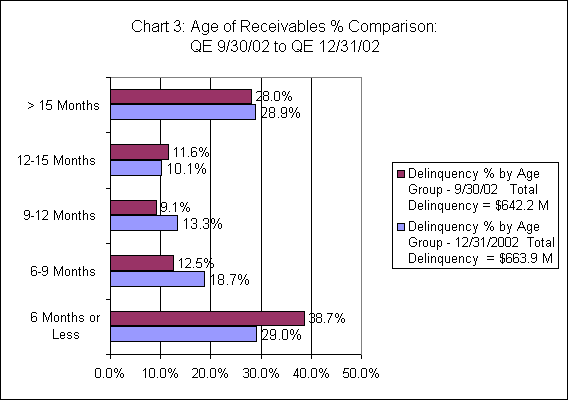
The distribution of receivables by age shows 29.0% at 6 months or less, 18.7% at 9 months or less, 13.3% at 12 months, 10.1% at 15 months, and 28.9% at Over 15 months. The largest changes, compared to the quarter ending September 30, 2002, were in the 6 months or less category (declined 9.7%) and the 9 months or less group (increased 6.2%).
See Table 5, Percent Distribution of Age of Receivables
Audit Activity
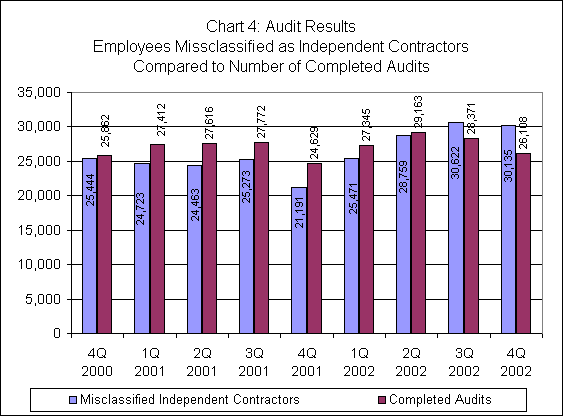
States audited the records of 26,108 employers during the fourth quarter, of which 696 were large employer audits. (By definition large employers have at least 100 employees or at least one million dollars in annual taxable payroll.) Total audit production for the quarter ending December 31, 2002, increased by 1,662 audits over the quarter ending December 31, 2001. The average time required for completing an audit remains unchanged at 7.4 hours and the average number of quarters audited was 4.6 quarters.
Through the audit program, a total of 30,135 workers were discovered to have been misclassified as independent contractors. This total is up 42% from the 21,191 reported in the quarter ending December 31, 2001. States were required to begin reporting this information with reports for the first quarter of 2000. However, six states (The District of Columbia, Indiana, Kentucky, Minnesota, Pennsylvania, and Virginia) appear to still be unable to collect and report this data, i.e., they reported "0" for this item for the report quarter ending December 31, 2002. The number of misclassifications range from zero (in the previously mentioned six states) to a high of 6,438 in California.
See Table 6, Audit Activity
Discrepancies in either wages or contributions due were discovered in 11,235 of the 26,108 audits that were completed, for a change rate of 43.0%. California reported the highest discrepancy rate; 282 of their 392 audits were discrepant, for a change rate of 71.9%. The audits revealed that total wages were under reported by $436,290,588 and over reported by $551,482,999 making a gross change in total wages of $987,773,587. As noted on page 2, the over reported amount is unusually high because of a single audit in Ohio that resulted in a Total Wage over reporting adjustment of $459,271,195. The large discrepancy was caused by erroneous data in their wage record system. Nationally, the audits completed during the quarter ending December 31, 2002, resulted in a net increase in contributions due of $5,656,675 or about $216.66 average per audit.
See Table 7, Audit Change in Total Wages and Contributions
Charts:
Chart 1 - Status Determinations Promptness QE 12/31/2002
Chart 2 - Filing Employer Contribution Reports QE 12/31/2002
Chart 3 - Age of Receivables % Comparison: QE 9/30/2002 to 12/31/2002
Chart 4 - Audit Results, Employees Misclassified as Independent Contractors QE 12/31/2002
Tables:
Table 1 - Status Determination Promptness
Table 2 - Filing Reports - Contributory Employers
Table 3 - Filing Reports - Reimbursing Employers
Table 4 - Collection Activities
Table 5 - Percent Distribution of Age of Receivables
Table 6 - Audit Activity
Table 7 - Audit Change in Total Wages and Contributions