
UI Benefit Accuracy Measurement Annual Report Overpayment Rate in Detail
Annual Report Overpayment Rate In Detail
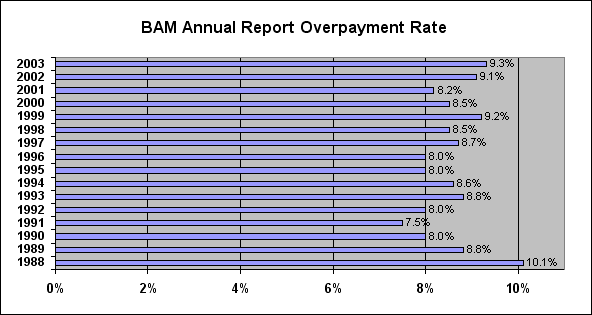
The estimated BAM Annual Report overpayment rates since the beginning of the program in calendar year (CY) 1988 are summarized in the following chart.
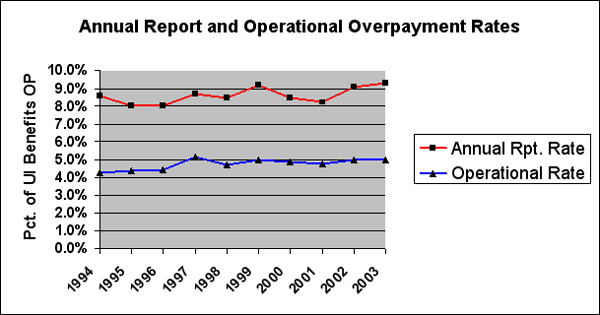
A subset of the Annual Report rate is the operational overpayment rate, which includes those overpayments that the states are reasonably expected to detect and establish for recovery -- fraud and nonfraud recoverable overpayments, excluding work search, employment service (ES) registration, base period wage issues and miscellaneous causes, such as benefits paid during a period of disqualification, redeterminations, and back pay awards. The following chart plots the BAM Annual Report rate and the operational rate for the last ten years. Because the operational rate is more narrowly focused than the Annual Report rate, it is less likely to fluctuate from year to year.
State Annual Report Overpayment Rates
| State | CY 2003 Overpayment Rate |
Change From CY 2002 (Percentage Pts.) |
Leading Cause (Percent Of UI Benefits Paid) |
|---|---|---|---|
| Kansas | 27.95% | +14.69 | ES Registration (23.73%) |
| Montana | 25.08% | +5.73 | ES Registration (13.56%) |
| Arizona | 21.95% | +5.02 | Work Search (14.19%) |
| Nebraska | 21.61% | +3.93 | ES Registration (11.72%) |
| Texas | 20.74% | +0.04 | Work Search (8.13%) |
| State | CY 2003 Overpayment Rate |
Change From CY 2002 (Percentage Pts.) |
Leading Cause (Percent Of UI Benefits Paid) |
|---|---|---|---|
| Oklahoma | 1.80% | -1.11 | Work Search (0.64%) |
| West Virginia | 2.01% | -1.19 | Benefit Year Earnings (0.92%) |
| Kentucky | 2.61% | -2.89 | Benefit Year Earnings (1.20%) |
| Vermont | 2.87% | +0.88 | Separation Issues (1.42%) |
| New Mexico | 2.98% | -0.84 | Separation Issues (1.74%) |
| State | Amount of UI Benefits Paid (In Millions) |
CY 2003 OP Rate (Percentage Pt. Change From CY 2002) |
State | Amount of UI Benefits Paid (In Millions) |
CY 2003 OP Rate (Percentage Pt. Change From CY 2002) |
|---|---|---|---|---|---|
| California | $6,100.9 | 6.80% (-0.45) | New Jersey | $2,085.2 | 11.37% (+3.14) |
| New York | $2,994.6 | 7.84% (-0.27) | Michigan | $1,865.5 | 9.17% (+1.00) |
| Pennsylvania | $2,700.4 | 7.83% (+0.07) | Massachusetts | $1,794.9 | 3.34% (+0.95) |
| Illinois | $2,465.5 | 8.04% (+0.22) | Washington | $1,512.2 | 11.05% (-1.19) |
| Texas | $2,170.1 | 20.74% (+0.04) | Ohio | $1,396.2 | 11.12% (+4.19) |
Note: Rates are the percentage of UI benefits that were overpaid.
Readers are strongly cautioned that it may be misleading to compare one state's payment accuracy rates with another state’s rates. No two states' written laws, regulations, and policies specifying eligibility conditions are identical, and differences in these conditions influence the potential for error. States with stringent or complex provisions tend to have higher improper payment rates than those with simpler, more straightforward provisions.
Changes in Annual Report Overpayment Rates
The estimated CY 2003 overpayment rate of 9.31 percent of benefits paid in the State UI, UCFE, and UCX programs is an increase of 0.23 percentage points from CY 2002. An estimated $3.81 billion of benefits were overpaid in CY 2003, compared with $3.67 billion overpaid in CY 2002. Most of the national increase in the overpayment rate is attributable to increases in the percentages of UI benefits that were overpaid due to separation, ES registration, benefit year earnings, and work search issues. The percentage of UI benefits overpaid due to able and available issues decreased by 0.22 percentage points.
It is important to note that BAM estimates are based on sample data. The observed changes in both the overall overpayment rate and the cause components are less than the variation attributable to sampling.
| Overpayment Cause | CY 2003 Percentage of UI Benefits Paid |
Percentage Point Change From CY 2002 |
|---|---|---|
| Benefit Year Earnings | 2.57% | +0.07 |
| Separation Issues | 2.14% | +0.20 |
| Work Search | 1.49% | +0.06 |
| ES Registration Issues | 0.97% | +0.08 |
| Base Period Wage Issues | 0.62% | -0.04 |
| Other Eligibility Issues* | 0.60% | 0.00 |
| Able & Available | 0.55% | -0.22 |
| Dependents and Other Issues | 0.37% | +0.08 |
* Includes work refusals, self-employment, and illegal alien status.
In CY 2003, 30 State Workforce Agencies (SWAs) reported increases in their overpayment rates from the previous year, and 22 SWAs reported decreases in their overpayment rates.
| State | Percentage Point Increase From CY 2002 |
Leading Cause of Increase (Percentage Point Increase) |
|---|---|---|
| Kansas | 14.69 | ES Registration (+13.44) |
| North Dakota | 5.86 | ES Registration (+3.78) |
| Montana | 5.73 | ES Registration (+4.74) |
| Arizona | 5.02 | Work Search (+5.97) |
| Alabama | 4.56 | ES Registration (+3.00) |
| State | Percentage Point Decrease From CY 2002 |
Leading Cause of Decrease (Percentage Point Decrease) |
|---|---|---|
| Louisiana | -4.65 | ES Registration (-3.85) |
| Rhode Island | -4.08 | Other Eligibility Issues (-0.93) |
| North Carolina | -3.76 | Work Search (-2.23) |
| Maryland | -3.74 | Benefit Year Earnings (-2.21) |
| Mississippi | -3.49 | ES Registration (-2.83) |
Overpayment Cause and Responsibility
Causes of Overpayments in CY 2003

The leading cause of overpayment errors in CY 2003 was unreported or erroneously reported benefit year earnings and income, including social security, pension, severance or vacation pay, which accounted for over one-fourth of the $3.81 billion overpaid and 2.6 percent of the $41 billion in UI benefits paid in CY 2003. Separation issues were the second leading cause of overpayments, accounting for 23 percent of the amount overpaid and 2.1 percent of benefits paid.
Leading Cause of Overpayments by State
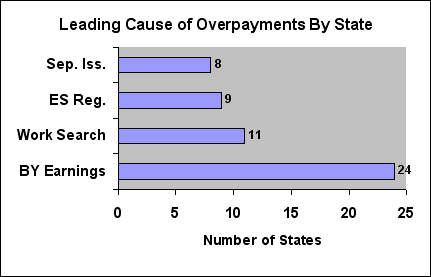
Unreported or erroneously reported benefit year earnings and income, including social security, pension, severance, or vacation pay were the leading cause of overpayment errors in nearly half of the states. Work search issues were the leading cause in 11 states, and employment service registration issues were the leading cause of overpayments in nine states. Separation issues were the principal cause of overpayment errors in eight states.
Overpayment Cause Trends
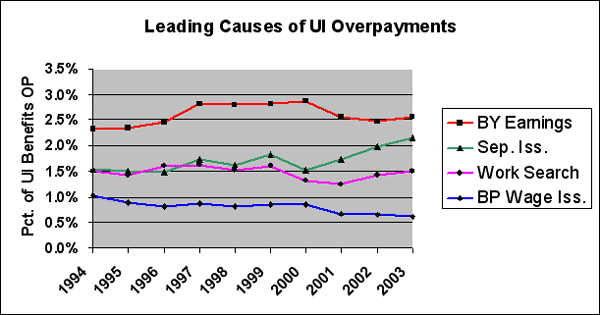
Over the last ten years, benefit year earnings (unreported or erroneously reported benefit year earnings, plus social security, pension, or severance/vacation pay) have accounted for the largest portion of overpayments. In recent years, separation issues have been the second leading cause of overpayments, and have increased in each of the last three years. Work search issues, the third largest cause of overpayments, increased for the second consecutive year and have returned to their 1994 level. The percentage of UI benefits that were overpaid because of errors in reporting or recording base period wage issues has decreased slightly in recent years as the automation of wage reporting has improved.
Responsibility for Overpayments in CY 2003
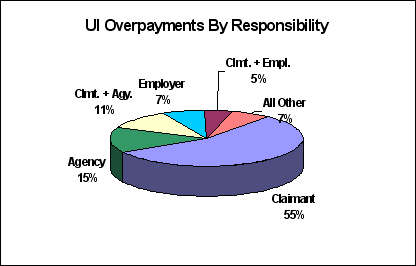
Claimants alone were responsible for 55 percent of the dollars overpaid; claimant responsibility accounted for overpayments representing 5.2 percent of total UI benefits paid in CY 2003. Errors resulting in overpayments that were attributed exclusively to the state agency accounted for 15 percent of the amount overpaid and represented 1.4 percent of the UI benefits paid. The category "All Other" includes overpayments for which more than one party has responsibility, such as agency and employers, as well as third parties.
Average Amount Overpaid
Another approach to measuring UI benefit payment integrity is to examine the average amount overpaid. Average overpayments can be expressed either in terms of the number of erroneous payments or in reference to a workload measure.
To identify an appropriate workload measure, overpayment errors are classified by cause: monetary (base period wage and dependents allowance issues), separation (voluntary quit and discharge), and nonseparation (benefit year earnings and income, able and available, work search, ES registration, refusal of work, alien status, and other continuing eligibility issues). The workload measure relates to points in the UI claims process at which an overpayment error can occur. For example, the state agency must determine that the claimant is monetarily eligible for benefits and that no disqualifying separation issue exists before a first payment is issued. Nonseparation issues relate to the claimant’s eligibility to receive benefits for continued weeks of unemployment compensation claimed. Workload measures are summarized in the following table.
| Cause | Workload Measure | CY 2003 |
|---|---|---|
| Monetary | Number of first payments | 10,037,865 |
| Separation | Number of first payments + Number of additional claims, excluding ACs for which a nonmonetary determination resulted in a denial | 16,844,092 |
| Nonseparation | Number of UI weeks paid | 165,593,046 |

Monetary overpayments average approximately $34 per erroneous payment. These errors generally represent a reduction of the claimant’s weekly benefit amount due to erroneously reported or recorded base period wages. However, most of these claimants remain eligible for some UI benefits. In contrast, separation overpayments often involve complete disqualification (due mostly to voluntary quits and discharges), resulting in an average overpayment of nearly $205 per erroneous payment. Nonseparation errors average $163 per overpayment and encompass several issues. Some of these, such as able and available and work search violations, result in total disqualification for the compensated week of unemployment, whereas other issues, such as earnings from part-time employment or income from social security or pensions result in a partial reduction of benefits for the week of unemployment that is affected.
The average overpayments per workload are computed by dividing the amount of benefits overpaid in each cause category by the appropriate workload measure. For example, BAM estimates that approximately $273 million were overpaid due to monetary issues. Dividing this amount by the 10,037,865 first payments results in an average overpayment of approximately $27. Average overpayments per workload for separation and nonseparation errors are significantly smaller than the average amount per overpayment. For example, dividing total overpayments due to separation issues ($877 million) by the nearly 17 million first payments and eligible additional claims* produces an average overpayment of $52. Nonseparation overpayments, which comprise issues related to the claimant’s continued eligibility during his or her benefit year (for example, benefit year earnings, able and available, and work search issues) totaled $2.7 billion, an average of $16 per UI week paid. These workload averages place overpayments in the context of the number of transactions and eligibility determinations made in the UI system.
* Additional claims are filed when a claimant returns to work during the benefit year before exhausting the maximum amount of UI benefits to which he or she is entitled, is separated from that employment, and files a claim for additional weeks of unemployment. The agency determines eligibility based on the circumstances of the claimant’s separation from the intervening employment.
Prepared by:
U. S. Department of Labor
Employment and Training Administration
Office of Workforce Security
Division of Performance Management
August 2004