Purpose. To inform the workforce investment system of observed differences in the counts of individuals who received training under the Job Training Partnership Act (JTPA) and Title I of the Workforce Investment Act (WIA.)
Background. The Employment and Training Administration recently compared information on the number of exiters [1] and the number of exiters who received training for Program Years 2000 and 2001 under Title I of WIA with information on exiters under WIA's predecessor, the JTPA. Information on WIA was obtained from the Workforce Investment Act Standardized Record Data (WIASRD); information on JTPA was obtained from the Standardized Program Information Reporting (SPIR) data. This and other reports and analyses of WIA performance and results can be seen on the Internet at http://www.doleta.gov/usworkforce/performance/.
Service Levels for Adults. The chart below shows trends in the number of adult exiters and trainees from PY 1998, the last year in which all states operated JTPA, to PY 2001. [2] The JTPA data include both Title II-A and the Section 204(d) older worker program. The data in the chart assume that adults who did not receive training under JTPA received other services comparable to intensive services under WIA. The JTPA data do not include individuals who received only objective assessments, because these individuals did not receive services intended to help them get a job or increase their skills. The WIA data do not include individuals who received only core services categorized as self-service or informational because they are not registered in WIA.

| JTPA PY 1998 | WIA PY 2000 | WIA PY 2001 | |
|---|---|---|---|
| Total Exiters | 163,223 | 112,151 | 172,366 |
| Core Services Only | 20,300 | 36,918 | |
| Intensive Services | 18,091 | 37,884 | 59,485 |
| Training | 145,132 | 53,967 | 75,963 |
The data in the chart show:
The total number of exiters declined significantly from JTPA PY 1998 to WIA PY 2000—from 163,233 to 112,151. Because PY 2000 was the first year of WIA for almost all states, the decline in exiters may be due to start-up problems and management information system conversion issues as states and local areas restructured their programs to meet WIA requirements.
The number of adult exiters increased substantially in PY 2001—to 172,366, which slightly exceeded the number of JTPA exiters in PY 1998. Thus, WIA is now serving slightly more adults than were served under JTPA. It should also be noted that a significant, but unknown, number of adults receive self-service and informational core services, but are not included in the WIA exit counts because they are not registered in WIA.
The number of adult exiters who received training declined significantly from JTPA PY 1998 to WIA PY 2000—from 145,132 to 53,967. This number reflects updated PY 2000 that includes all states.
The number of adult exiters receiving training increased in PY 2001—to 75,963. However, this number is still well below the number who received training under JTPA. There are several explanations for this decrease. First, with minor exceptions, all JTPA participants were expected to receive training. In contrast, WIA is designed to provide a wide range of services—including both core and intensive services in addition to training. Second, some services counted as training under JTPA are categorized as intensive services under WIA (one example is short-term prevocational services).
In summary, the data show that after experiencing start-up problems in PY 2000, WIA is serving slightly more adults than were served under JTPA. If the adults receiving core services categorized as informational or self-service were counted, WIA may be serving many more adults. However, the reliance on training has decreased substantially due to the broader range of services the WIA is intended to provide.
Service Levels for Dislocated Workers. The chart below shows trends in the number of dislocated worker exiters and trainees from PY 1998 to PY 2001.
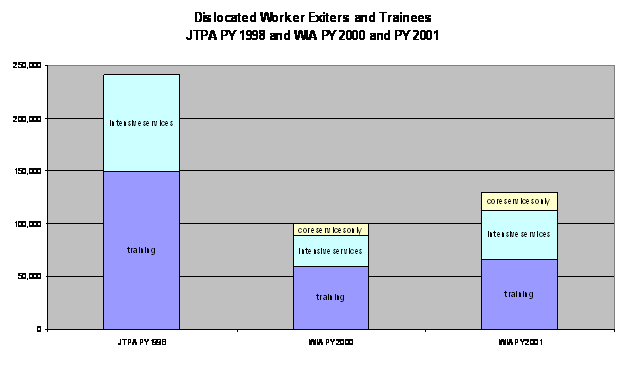
| JTPA PY 1998 | WIA PY 2000 | WIA PY 2001 | |
|---|---|---|---|
| Total Exiters | 240,896 | 99,611 | 129,969 |
| Core Services Only | 10,840 | 17,777 | |
| Intensive Services | 91,697 | 29,241 | 46,000 |
| Training | 149,199 | 59,530 | 66,192 |
The data in the chart assume that dislocated workers who received basic readjustment services, but not training, under JTPA, received services comparable to intensive services under WIA. The WIA data do not include individuals who received only core services categorized as self-service or informational.
The data in the chart show:
A significant decline in the number of dislocated worker exiters from JTPA PY 1998 to WIA PY 2000—from 240,896 to 99,611. The WIA data may undercount exiters from National Emergency Grants—only 8,476 were reported in PY 2000. However, this undercount would explain only a small portion of the decline in total exiters.
A modest increase in the number of exiters from PY 2000 to PY 2001—to 129,969. However, the number of exiters from WIA in PY 2001 was still far below the number of exiters from JTPA in PY 1998.
Relative stability in the service mix, compared to services provided to the WIA adult population. The percentage of dislocated workers who received training declined from 62 percent in JTPA PY 1998 to 60 percent in WIA PY 2000 to 51 percent in WIA PY 2001. Nonetheless, the number of dislocated workers who received training dropped substantially, and is likely related to the decline in the total number of exiters.
Action Required. Please make this information available to appropriate program staff.
Inquiries Questions regarding this information should be directed to ETA’s Performance and Results Office at 202-693-3031.