Only two other surveys have been conducted on the topic of employee leasing. In 1989, the State of Louisiana conducted an informal survey of States to determine the extent to which employee leasing is permissible within States and sought applicable State laws. In 1990, the Interstate Conference of Employment Security Administrators (ICESA) surveyed the States and obtained information about State laws governing employee leasing and problems encountered with the leasing industry. However, neither survey produced definitive information because of low response rates and other methodological issues.
The KRA Corporation (KRA) survey was designed to gain an understanding of how States are currently dealing with the employee leasing industry and to obtain a more accurate picture of the impact of employee leasing on State UI systems. In September 1994, KRA initiated a survey of State UI tax administrators that asked questions about definitions of employee leasing, applicable State laws, effects on the UI trust fund, industry size and employment, reported industry classifications, registration requirements, bonding requirements, client firm reporting requirements, failure rates of leasing companies, experience-rating procedures, and associated changes in successor rules. The survey instrument is found in Appendix A.
The mail survey was conducted between September 1 and November 1, 1994. Follow-up telephone calls were made to obtain additional data or clarify responses. Surveys were received from all 50 States and the District of Columbia. Data cleaning and database construction were completed as surveys were received, and data analysis was conducted during January 1995. The remaining sections of this chapter present the data collected through the survey.
As more States have experience with the employee leasing industry, the number of States with legislation governing the industry has increased. The ICESA survey of 1990 indicated that 13 States had laws governing coverage of employee leasing companies, with another 17 States having a rule or policy governing employee leasing. The results of the KRA survey show that 25 States now have laws governing the operation of employee leasing companies, and 35 States have at least a working definition of employee leasing or a definition in legislation, regulation, or agency policy. Appendix B contains a State-by-State summary of laws and regulations pertaining to employee leasing. This information was obtained through the survey and supplemented by a review of State UI laws. Citations of workers' compensation laws and regulations may be incomplete.
Responses to the survey question on the reasons for enacting employee leasing legislation varied. Some States reported that legislation was passed in reaction to problems encountered and concerns about abuse, whereas others reported that legislation was precautionary and intended to avoid problems encountered in other States. Other reasons given for the passage of State legislation were the following:
To support agency rulings, such as the determination of who the employer is.
To regulate such issues as tax liability and experience rating.
To clarify the rights and responsibilities of client firms.
To clarify the rights and responsibilities of leasing companies. (In some States, legislation was encouraged by the leasing industry.)
Given the different reasons for employee leasing legislation and the fact that the growth of the leasing industry has been fueled by increases in employee benefit costs, it is not surprising that State laws addressing employee leasing are found in various sections of State statutes. Some are contained within the UI section of the statutes, whereas others exist in the general business regulation, taxation, or workers' compensation sections. This inconsistency contributes to the variation in the provisions of the laws and also leads to situations where, for purposes of UI, no provisions exist, but for workers' compensation, extensive guidelines are contained in legislation.
The varying reasons for enacting legislation also contribute to varying effects. Fifteen respondents indicated that legislation increased regulation of the industry; however, only one respondent reported slowed industry growth or a reduction of industry size due to legislation. Eleven respondents indicated that the legislation resulted in increased reporting requirements, in some cases due to a provision in the law that requires employee leasing companies to provide additional data or lists of client firms. Nine respondents reported an increase in financial entry requirements that are often associated with licensing fees or bonding requirements. When asked about the effect of legislation, the most common response was that it was too early to tell. Many State statutes were passed in the late 1980's or early 1990's, and, States have not had adequate time to assess the effects of the legislation.
A common feature of many State employee leasing laws is a definition of the employee leasing arrangement or employee leasing company. Twenty-five States have such a definition in their law, with another four States defining employee leasing through regulations. Only 14 States do not have a working definition or a definition of employee leasing in any legislation, regulation, or agency policy. State definitions are contained in Appendix C.
The determination of the employing unit is a common provision in State definitions. Some States consider the employee leasing company the employer under all circumstances, but others consider the leasing company the employer of leased employees only if the firm meets certain criteria. Other provisions contained in legislated definitions include the requirement that a leasing company maintain "direction and control" to be considered the employer of leased employees. Further discussion of determining the employer of leased employees is contained in Section 3.3.1.
State definitions utilize a variety of criteria to distinguish employee leasing from other types of firms or employment relationships. Twelve States specify that to be an employee leasing arrangement, staff placement must be ongoing or long-term in nature (although only one State specifies the period that meets the ongoing or long-term requirement). Other criteria used to distinguish employee leasing from other types of firms include the receipt of a fee (seven States) and requirements that the lease arrangement cover all or a significant portion of a client firm's staff (three States).
One purpose of legislated definitions is to distinguish employee leasing from temporary help firms. Distinguishing between employee leasing and temporary help firms is no small matter. First, both are included in SIC 7363 Help Supply Services. Further, employee leasing firms may also provide temporary help (and vice versa). BLS is trying to encourage different reporting standards for employee leasing and temporary help firms, with temporary help firms reporting all of their employment in SIC 7363 and employee leasing firms reporting their leased employees according to the SIC of their client firms.1
The extent to which States attempt to distinguish between employee leasing and temporary help firms varies. Five States do not attempt to distinguish between the two types of firms or use a single definition for both. In addition to (or in place of) legislated definitions, States use other characteristics to distinguish between leasing and temporary help firms. Thirty States indicated they have discussions with leasing company managers to determine the type of business being conducted. Another common distinguishing characteristic is the word "leasing" in the firm's name (18 States). Other ways State staff distinguish employee leasing from temporary help firms is by requiring special licensing of leasing companies, by assessing the ength of placements made by the firm, and by legislative registration requirements for leasing companies.
Two primary questions underlie most State laws and policies governing the employee leasing industry: "Who is the employer of leased employees?" and "Who is liable for unemployment contributions?" To answer these two questions, States have regulated the industry in a variety of ways. The methods for determining the employer of leased employees and regulation of the industry including registration requirements, bonding, reporting requirements, experience rating procedures, and successorship determination are discussed below.
Determining the employer or the employing unit is a key factor in understanding who is responsible for reporting and making contributions as required by the UI system. Historically, considerations such as who maintains "direction and control" of the employees, who has the right to hire and fire, and who pays the employee have led to determinations of who is the employer. Many of the same factors are considered when determining whether the employee leasing company or the client firm is the employer of leased employees. However, because of the nature of employee leasing, determining who has direction and control or the authority to hire and fire is often difficult.
According to the survey responses, 27 States consider the employee leasing company the employer of leased employees, while 9 consider the client firm the employer. Of the remaining 14 respondents, 5 indicated that the employer was whoever maintained direction and control of the leased employees. Other States require that the leasing company meet criteria such as the seven-point test below to be considered the employer:
Negotiates with clients or customers for such matters as time, place, type of work, working conditions, quality, and price of services
Determines assignments or reassignments of workers, even though workers retain the right to refuse specific assignments
Retains the authority to assign or reassign a worker to other clients or customers when a worker is determined unacceptable by a specific client or customer
Assigns or reassigns the worker to perform services for a client or customer
Sets the rate of pay for the worker, whether or not through negotiation
Pays the worker from its own account or accounts
Retains the right to hire and terminate workers
Some States do not require that all seven criteria be met; rather, they use some combination of three or five of the criteria. Other reported State considerations include who benefits most from the leased employment, whether or not the employee leasing company has posted a bond, and the provisions of the contract between the leasing company and the client firm. Four States indicated that each case is reviewed separately but did not specify the criteria used to determine the employing unit.
In some States, special considerations are made when determining the employer of partners/sole proprietors and corporate officers. Most State laws prohibit payment of UI benefits to sole proprietors or partners, the theory being that they are self-employed and, therefore, cannot be laid off. If the leasing company pays their salaries and UI contributions, they may be monetarily eligible for benefits, should they be separated from the firm (the leasing company). The other side of the situation is that it would, in most cases, represent a windfall to the UI trust fund, because these individuals would be very unlikely to actually collect benefits.
Thirty-seven States consider partners/sole proprietors to be owners and therefore not eligible for UI benefits. In these cases, the employee leasing company is most likely serving merely as a payrolling firm for those individuals. Only six States responded that a partner/sole proprietor is considered an employee of the leasing company, whereas one considered those individuals employees of the client firm. Some States determine the employer of partners/sole proprietors based on who reports wages, whereas others make case-by-case determinations. Based on the premise that an individual cannot be leased to him or herself, one State does not allow owners to be part of a lease arrangement.
The entity considered the employer of corporate officers varies more significantly than for partners/sole proprietors. Twenty-one States consider corporate officers employees of the leasing company, and 18 consider them employees of the client firm. Two States responded that corporate officers are considered owners and are therefore not eligible for UI benefits, but two others indicated that corporate officers may be considered in dual employment.
Because of the unique nature of an employee leasing arrangement, determining liability for UI contributions and the appropriate amount of contributions can be difficult. In general, 22 States hold the employee leasing company liable for contributions, but 10 States consider the client firm to be liable if contributions are not paid by the leasing company. Nine States consider the client firm jointly and severally liable for contributions, although five States allow relief from liability if a bond is posted by the leasing company. Other States consider issues of direction and control and who is, by definition, the employer of leased employees when determining tax liability. Determining tax liability and recovering contributions are aided by reporting and registration or licensing requirements. Both of these topics, as well as bonding, experience rating, and successorship provisions, are discussed in more detail below.
Registration requirements are one way States identify employee leasing companies for purposes of assessing UI tax liability. As shown in Exhibit 3-1, 19 States reported that they have registration requirements for employee leasing companies. In some cases, the registration is the same as that required of all firms, whereas other States require special registration or licensing of leasing companies. Registration requirements have been recently
Exhibit 3-1
Unemployment Insurance Service Department of Labor
Registration Requirements by State and ReasonReasons for Registration Requirement STATE Registration
RequirementYear
RequiredTo track
Industry
GrowthTo ensure
UI Taxes
Are
paid propertyTo distinguish
employee
leasing
from
temporary
helpTo ensure
proper SICs
of
client firms
are reportedAK N AL N AR Y 1987 AZ N CA N CO N CT Y 1989 Y Y Y Y DC N DE N FL Y 1992 Y N Y N GA Y 1992 N Y Y N HI Y 1987 N Y N Y IA N ID N IL N IN N KS Y 1990 N Y N N KY N LA N MA Y 1993 Y Y Y Y MD N ME Y 1991 N Y Y N MI N MN Y 1992 Y N Y N MO N MS N MT N NC N ND N NE N NH Y 1994 Y Y Y Y NJ N NM Y 1994 NV Y 1994 Y Y Y N NY N OH N OK N OR N PA N RI Y 1992 N Y N N SC Y 1994 N N N N SD TN Y 1996 N N Y N TX Y 1994 N Y Y N UT Y VA VT Y 1989 Y Y N Y WA N WI N WV N WY Y 1989 N Y N N Affirmative Responses 19 7 12 10 5
implemented, with 11 States requiring registration as recently as 1992. When asked about the reasons registration is required of employee leasing companies, the most frequent response was to ensure that UI taxes are paid properly. Other common reasons were to distinguish employee leasing from temporary help firms, to track industry growth, and to ensure proper SIC reporting of client firms. Additional reasons include the following:
To ensure adequate coverage for leased workers
To identify joint and several liability
To prevent leasing companies from circumventing proper workers' compensation rate computations
To ensure that experience rating is uniform
To identify a client firm's entry in an employee leasing arrangement, as well as its exit
Because registration or a licensing requirement is often a recent addition to policy governing employee leasing, most States are not sure if it has accomplished its goals. Twelve of 13 States responding indicated that registration has helped ensure that all UI taxes are paid properly, whereas 8 States noted registration has assisted in distinguishing employee leasing from temporary help firms. Eight States also reported that registration has helped track industry growth, whereas five States indicated proper SIC reporting has been assisted by registration. Some States commented that although registration requirements are in place, they are not sure that all firms required to register actually do so.
Another way States track employee leasing companies and their clients is through submitting lists of client firms. Currently, 24 States require the submission of a list of client firms, with 1 State requiring client lists as of 1995 and another State having such a requirement pending legislative approval. Lists of client firms are required in some States so that client firms can be considered the employer and held liable for contributions unpaid by the leasing company. Other States use such lists to ensure correct reporting by the leasing company, and still others use the lists to ensure proper predecessor/successor designations and experience-rated tax rate computation.
Some States require employee leasing companies to submit information in addition to a list of client firms, such as addresses and SICs of client firms. Exhibit 3-2 shows States with client firm reporting requirements and the additional information collected. The most common information collected, in addition to client lists, is the number of employees leased to client firms. These requirements can be important to proper reporting of employment by industry in the ES 202 reporting system. Absent reporting requirements, employee leasing firms may aggregate all their leased employees in Help Supply Services (SIC 7363) rather than by the industry of their client firms.
Exhibit 3-2
Unemployment Insurance Service
Department of Labor
Client List Requirements by State and
Type of InformationAdditional Information Required STATE Client List
RequiredYear
RequiredLeased
Employment
at Client FirmSIC Codes
of Client
FirmsMultiple
Worksite
ReportsEmployer
Ids of Client
FirmAK N AL N AR Y AZ N CA N CO Y 1993 N Y Y N CT Y 1989 N N N Y DC N DE N FL Y 1987 Y N N N GA Y 1992 N N N N HI N IA Y 1990 Y Y Y N ID Y 1994 Y Y Y N IL N IN N KS Y 1990 Y Y Y N KY N LA Y 1994 Y Y Y Y MA Y 1993 Y N N Y MD Y N N N Y ME Y 1991 Y N Y N MI N MN Y 1995 MO Y 1992 Y N Y N MS N MT N NC ND N NE Y 1992 Y N N Y NH Y 1994 Y N Y N NJ Y PROPOSED Y N N Y NM N NV Y 1994 Y N Y Y NY N OH N OK N OR N PA N RI N SC Y 1994 Y N N N SD TN N TX Y 1994 Y Y Y Y UT Y 1991 Y N Y N VA N VT Y 1989 Y Y N N WA N 1993 N N N Y WI N WV N N N Y N WY Y 1989 Y N Y N Affirmative Responses 24 17 7 13 9
Bonding requirements are used in two ways relative to leasing arrangements. First, some States require that employee leasing companies post a bond to ensure that the firm is financially solvent. Presumably, the bond ensures that if a leasing company goes out of business with delinquent contributions, the company has a sufficient net worth to allow for the recovery of amounts owed. Employee leasing companies are not generally considered to have significant material assets (i.e., buildings and equipment) that can be liquidated to pay delinquent contributions or wages owed to employees. Second, some States require that employee leasing companies post a bond to cover delinquent contributions or to relieve client firms of joint and several liability for contributions. The concern is to avoid having client firms paying UI contributions twice, once to the leasing company and again when the leasing company fails to pay.
Currently, only two States require that employee leasing companies post a bond; however, five other States have provisions for optional bonding as a method of proving financial solvency or relieving client firm liability. Bond amounts in most States are flat amounts specified in legislation or regulation. The bond amounts vary from $10,000 to $100,000. One State requires a flat amount or the amount equivalent to 2.7 percent of the leasing company's payroll, whichever is greater. Another State requires a bond equal to $100,000 or the amount of UI contributions the leasing company was liable for in the last year, whichever is greater. Some States have provisions that reduce the size of the bond if the leasing company pays required contributions, usually for 3 consecutive years.
Few responses to questions about liabilities covered by the bond were received. State legislation pertaining to bonding indicates that most bonds are to ensure the prompt payment of contributions, interest, and penalties for which the leasing company is liable. In some cases, the bond is to cover wages and benefits for which the leasing company is liable, although "benefits" is not defined and it is unclear if benefits includes unemployment contributions.
Experience rating is a key factor in determining the amount of payroll contributions any company must pay. In the case of leasing companies, it is not always clear how the experience of a leasing company should be computed. For example, some States consider the experience rate of the client firm when determining the rate for the leasing company, and others maintain different experience rates for each of a leasing company's client firms. However, the overwhelming majority of States (44 of 50 responding) apply a single tax rate to the leasing company based on the overall experience of the leasing company. Only in those States that consider the client firm's experience when determining the leasing company's rate does the method of establishing experience rates differ from the method used for temporary help firms. Generally, temporary help firms have a single experience rate, and their client firms' rates are not considered in any way.
Another consideration in determining both tax liability and the appropriate experience rate is the predecessor/successor relationship between a client firm and an employee leasing company. Some States do not consider the employee leasing company the successor to the client firm because the leasing company only takes over the employees and human resource functions from the client, not the assets or production function. Exhibit 3-3 shows each State's successorship provision as it pertains to employee leasing. Most States indicated that employee leasing companies may not transfer the experience of client firms under their State's successorship provisions, whereas some States allow the leasing company to be the successor to the client firm. A few States commented that the leasing company is automatically considered the successor to the client firm. Generally, States indicated that employee leasing companies are treated like any other firm when considering potential predecessor/successor relationships. Only two States responded that the growth of the employee leasing industry has resulted in the altering of State successorship provisions.
The 1987 revisions to the Standard Industrial Classification Manual include employee leasing in the 7363 Help Supply Services category. That classification also includes temporary help services, office help supply services, labor pools, and manpower pools. Because of the variety of services included in the 7363 classification, determining the size of the employee leasing industry separate from other 7363 activities is difficult. In States where leasing companies are required to register or obtain a license, an estimate of the leasing industry separate from the other 7363 activities may be more accurate. However, as stated previously, only 19 States have such a requirement.
Further complicating industry estimates is the method by which firms are classified by industry. Industry classifications are based on the firm's principal economic activity, although many firms engage in several activities. This assignment is particularly important in reference to employee leasing companies because they may supply employees to client firms conducting several different activities. Therefore, the potential for misclassifying leased employees is greater than for other firms. In addition, in States where lists of client firms are not required, it is possible that not all leased employment is reported in the appropriate SIC.
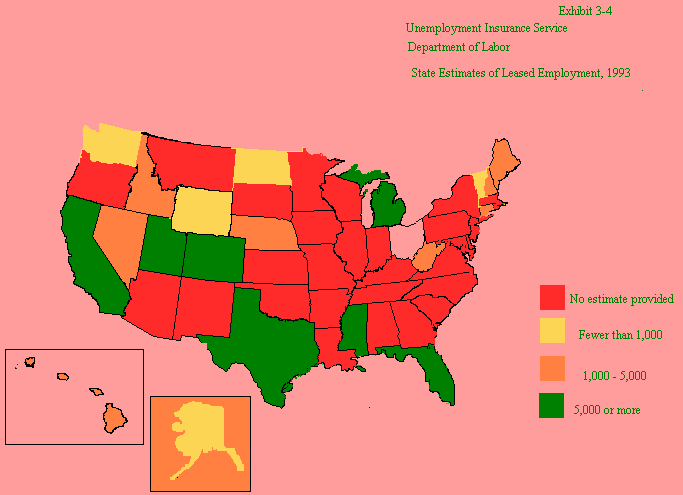
Exhibit 3-4 shows the geographic distribution of estimates of leased employment in 1993. Twenty-four States provided estimates, ranging from 1 to more than 100,000 leased employees. The average number of leased employees per State is 25,342. Total leased employment in States able to provide estimates was 608,198. The States that require the submission of client lists account for 46 percent of the total (278,888 leased employees). State estimates of the leasing industry show variable growth between 1989 and 1993. Estimates of leased employment for previous years were also requested and are provided in Exhibit 3-5.
Exhibit 3-3
Unemployment Insurance Service
Successoroship Provisions by StateSTATE May not
transfer Client
experience recordMust maintain client
experience record
and tax rateTreated like
any other
firmAK x x AL x AR x x AZ x x CA x CO x CT x DC x DE FL x x GA x x HI x IA x ID x x IL x IN x KS x x KY x LA x MA x MD x ME x MI x MN x x MO x MS x x MT x NC x ND x NE x NH x NJ NM x NV x NY x OH x x OK x OR x PA x RI x SC x x SD TN x x TX x UT x VA x x VT x x WA x x WI x x WV x WY x x TOTAL 26 3 36
Exhibit 3-5
Unemployment Insurance Service
Department of Labor
State Estimates of Leased Employment,
1989-1993State Client firm
Reporting
RequirementYear
Reporting
Required1989 1990 1991 1992 1993 AK N 817 AL N 12,142 14,358 18,372 24,982 28,941 AR Y AZ N CA N 260,000 CO Y 1993 9,173 CT Y 1989 827 1,004 1,050 1,153 1,214 DC N DE N 1 FL Y 1987 35,106 68,739 84,907 90,056 113,773 GA Y 1992 HI N 1,800 2,055 2,600 IA Y 1990 ID Y 1994 2,187 2,210 1,971 2,534 3,681 IL N IN N KS Y 1990 KY N LA Y 1994 MA Y 1993 MD Y 942 1,215 ME Y 1991 833 1,733 2,650 4,850 3,849 MI N 500 1,600 3,200 7,200 11,000 MN Y 1995 MO Y 1992 MS N 15,000 MT N NC ND N 200 200 200 200 200 NE Y 1992 1,000 NH Y 1994 1,500 1,500 2,500 3,000 3,507 NJ Y Proposed NM N NV Y 1994 3,500 NY N OH N OK N OR N PA N RI N 4,000 6,200 SC Y 1994 SD TN N TX Y 1994 40,000 60,000 85,000 100,000 125,000 UT Y 1991 6,257 6,741 11,958 VA N VT Y 1989 50 300 400 500 668 WA N Requested 500 700 WI N WV N 2,497 2,776 2,635 3,064 3,851 WY Y 1989 350 Total 24 97,642 154,420 211,197 249,722 608,198 Total of States Requiring Client List Reporting 80,503 135,486 184,735 209,776 278,888
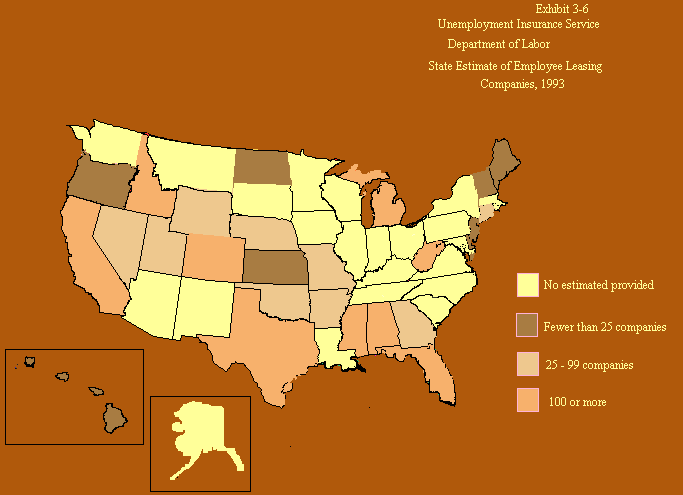
Exhibit 3-6 shows the geographic distribution of estimates of employee leasing companies. Twenty-nine States were able to provide estimates of the number of employee leasing companies in their State in 1993. The total estimated number of firms was 2,297. Of the 29 States providing estimates, 19 require that employee leasing companies register or maintain a license to conduct business in that State. These 19 States account for only 757 of the 2,297 firms estimated for 1993 (33 percent). Growth in the number of employee leasing companies has also been variable. The estimated number of companies increased by only 25 percent between 1991 and 1992, although the period 1992 to 1993 showed a 56-percent increase.
This higher growth rate in recent years may be due to recent registration requirements as opposed to actual industry growth. Estimates of the number of leasing companies for previous years are shown in Exhibit 3-7.
Nineteen States indicated that they record the SICs of leasing company client firms or their employment in the appropriate SIC. Although leased employment is historically thought to be found in such employment as medical office staff, legal assistants, or office support, the survey responses indicate that leased employment is found in a variety of industries. When the survey asked about the major industry of client firms, the most frequent response (30 respondents) was the service industry. However, within the service industry, responses varied from Hotels and Motels (SIC 7011) to General Automotive Repair Shops (SIC 7538) to Public Relations Services (SIC 8743). Other common responses of industries of client firms were manufacturing, transportation, and retail trade. A complete list of the reported industries of client firms is found in Exhibit 3-8.
Because so few States require reporting of client firms' SICs, it is difficult to determine if there have been shifts in the reporting of the workforce from one industry category to another. When queried on this topic, 15 States indicated that the growth of the industry has resulted in shifts in reported employment. However, 25 States indicated they could not determine whether such shifts have occurred.
For the States that do require reporting of employment by client SICs, only three indicated that there has been a noticeable change in the industry mix in the last 5 years. Again, the low response may be caused by limited collection and monitoring of such data.
Improper reporting of employment by SICs could have significant effects on the data reported at both the Federal and State levels. Nonetheless, few States collect information that allows them to determine the frequency of improper reporting. Of the States collecting SICs of client firms, only nine indicated that there have been instances of improper reporting, with six of the nine states categorizing those instances as infrequent (5 percent to 10 percent of leasing companies misclassifying their leased employees).
Exhibit 3-7
Unemployment Insurance Service
Department of Labor
State Estimates of Employee Leasing Companies
1989-1993State Registration
RequirementYear
Reporting
Required1989 1990 1991 1992 1993 AK N 15 19 25 28 40 AL N 229 260 280 310 319 AR Y 1987 AZ N CA N 1,368 CO N 152 CT Y 1989 22 24 28 32 43 DC N DE N 0 0 0 0 1 FL Y 1992 138 153 171 151 147 GA Y 1992 60 HI Y 1987 9 8 6 IA N ID N 90 100 102 117 133 IL N IN N KS Y 1990 32 29 19 16 5 KY N >LA N MA Y 1993 MD N 4 11 13 14 17 ME Y 1991 8 12 19 23 19 MI N 50 175 400 MN Y 1992 MO N 25 60 MS N 100 MT N NC N ND N 5 5 7 7 7 NE N 10 20 30 40 50 NH Y 1994 6 8 9 10 12 NJ N 10 NM Y 1994 NV Y 1994 40 NY N OH N OK N 9 27 27 50 50 OR N 22 PA N RI Y 1992 3 18 20 SC Y 1994 SD TN Y 1996 TX Y 1994 100 150 200 250 300 UT Y 40 41 50 VA VT Y 1989 2 8 10 12 14 WA N WI N WV N 107 109 129 150 179 WY Y 1989 0 0 0 0 41 Total 19 786 935 1,170 1,469 3,665 Total of States With Registration Requirements Reporting 317 384 507 553 757
| Exhibit 3-8 Unemployment Insurance Service Department of Labor Reported Standard Industrial Classifications of Client Firms |
|
| Construction | |
| 15 | Construction |
| 1522 | General Contractors - Residential Buildings, Other Than Single-Family |
| 1731 | Electrical Work |
| 1761 | Roofing, Siding, and Sheet Metal Work |
| Manufacturing | |
| 20 | Meat Products |
| 28 | Chemicals and Allied Products |
| 2452 | Prefabricated Wood Buildings and Components |
| 2752 | Commercial Printing, Lithographic |
| 3444 | Sheet Metal Work |
| 3484 | Small Arms |
| 3944 | Games, Toys, and Children's Vehicles, Except Dolls and Bicycles |
| 3999 | Manufacturing Industries, nec. |
| Transportation | |
| 42 | Trucking |
| 4212 | Local Trucking Without Storage |
| 4213 | Trucking, Except Local |
| 4215 | Courier Services, Except by Air |
| 4724 | Travel Agencies |
| Wholesale Trade | |
| 5049 | Professional Equipment and Supplies, nec. |
| 5099 | Durable Goods, nec. |
| 5112 | Stationery and Office Supplies |
| Retail Trade | |
| 53 | General Merchandise Stores |
| 5541 | Gasoline Service Stations |
| 5734 | Computer and Computer Software Stores |
| 5736 | Musical Instrument Stores |
| 5812 | Eating Places |
| 5813 | Drinking Places (Alcoholic Beverages) |
| 5943 | Stationery Stores |
| Finance, Insurance, and Real Estate | |
| 63 | Insurance Carriers |
| 6411 | Insurance Agents, Brokers, and Service |
| 6531 | Real Estate Agents and Managers |
| Services | |
| 7011 | Hotels and Motels |
| 7216 | Drycleaning Plants, Except Rug Cleaning |
| 7331 | Direct Mail Advertising Services |
| 7342 | Disinfecting and Pest Control Services |
| 7349 | Building Cleaning and Maintenance Services, nec. |
| 7363 | Help Supply Services |
| 7371 | Computer Programming Services |
| 7379 | Computer Related Services, nec. |
| 7389 | Business Services, nec. |
| 7513 | Truck Rental and Leasing, Without Drivers |
| 7534 | Tire Retreading ad Repair Shops |
| 7538 | General Automotive Repair Shops |
| 7542 | Carwashes |
| 8011 | Offices and Clinics of Doctors of Medicine |
| 8051 | Skilled Nursing Care Facilities |
| 8052 | Intermediate Care Facilities |
| 8059 | Nursing and Personal Care Facilities, nec. |
| 8062 | General Medical and Surgical Hospitals |
| 8072 | Dental Laboratories |
| 8111 | Legal Services |
| 8721 | Accounting, Auditing, and Bookkeeping Services |
| 8731 | Commercial Physical and Biological Research |
| 8743 | Public Relations Services |
| 8748 | Business Consulting Services, nec. |
| Miscellaneous | |
| 1381 | Drilling Oil and Gas Wells |
| 781 | Landscape Counseling and Planning |
| 913 | Commercial Fishing-Shellfish |
Most employee leasing problems encountered by States are identified through industry monitoring. However, because the employee leasing industry is relatively new, State efforts to monitor the industry vary. In some States, monitoring efforts are driven by encountered problems, although other States conduct consistent monitoring of employee leasing companies because they are considered prone to high turnover of firms. Only a small number of States can identify failures of leasing companies. Although survey results indicate that the frequency of failures is low, the associated cost to the trust fund for some cases may be high.
Only 26 States indicated that the employee leasing industry is monitored by UI staff, and the level of effort across these 26 States varies widely. For example, one State with extensive registration and reporting requirements dedicates 1« positions within the Tax Department for full-time monitoring, yet another State without registration requirements reported that monitoring is minimal because of the difficulty of identifying leasing companies. Other responses to questions about the level of effort dedicated to monitoring the employee leasing industry include the following:
A total of 30 hours per quarter to review delinquent accounts and reporting requirements
Periodic review of leasing companies' master tax files, including review of tax rates, delinquencies (monetary and reporting), covered workers, and benefit charges
No monitoring for the leasing industry that would not be conducted for any industry prone to rate manipulation and high turnover of firms
Annual contacting of leasing companies to ensure proper reporting of clients
Limited monitoring through ES 202
Periodic monitoring by random checks to ensure compliance with State law
States reported a variety of problems encountered with employee leasing companies. The most commonly reported problem was employee leasing companies with delinquent payroll taxes (35 States). In addition, 27 States reported they had problems with firms with unpaid UI trust fund contributions that filed for bankruptcy, and 24 States indicated they had identified instances of payroll tax manipulation. The following problems were also reported:
Leasing companies reporting employees to other States with lower tax rates
Not knowing an employer with delinquent payments has signed on with a leasing company and wages for the delinquent quarter being reported by the leasing company
Knowing whether all employees are reported if leasing companies do not provide client lists or a list of job sites
Firms setting up a leasing company to circumvent worker's compensation and UI rates and charges
Previously uncovered services being reported under leasing
Leasing companies acquiring another entity and transferring clients to obtain a lower tax rate
Collecting delinquent payments from leasing companies located out of State
Corruption of statistical information on types of employers (employment by appropriate SIC)
Because of variations in registration and reporting requirements, only 15 States could identify the number of employee leasing companies inactivated with delinquent account balances. Of these 15 States, 54 such occurrences were identified in 1993, with a total associated dollar value of $787,286. It should be noted, however, that most States reported fewer than five occurrences2; and the dollar values per State range, on average, from $1,351 to $222,535.
When asked to compare the occurrences and dollar values of delinquencies in the leasing industry with other industries, most States were unable to respond. Only four States responded that the number of occurrences and dollar amounts were higher than the temporary help industry, and only two States reported that the incidence was higher than those in all other industries. One State reported that the dollar amounts were higher than in other industries but that there were fewer occurrences.
Because of the limited data available on employee leasing companies, the effects of the industry remain difficult to determine. Given what is known about the industry, however, the potential effects are significant. For example, the large number of States holding employee leasing companies liable for payroll contributions, coupled with the small number of States securing bonds and lists of client firms, leaves the potential for losses to the State trust fund when employee leasing companies with delinquent contributions go bankrupt. Additionally, without registration and reporting requirements, States may not have a complete understanding of the size of the employee leasing industry and the composition of client firms. This lack of information could result in lower levels of contributions than should be collected.
Because most States do not have reporting systems in place to track employee leasing companies and their client firms, tax rate effects remain difficult to determine. Although most States indicated there had been no significant tax rate effects caused by the employee leasing industry, three States did respond that employee leasing had raised tax rates statewide because of ineffective charges. One State specified that although the effect could not be determined, it was not insignificant. However, several States indicated that the effect could not be determined.
As discussed above, liability for payroll contributions and recovery from employee leasing companies that default have potential effects on the UI trust fund. Once again, however, because of the limited data collected on the employee leasing industry, specific effects are difficult to determine. Responses from States that commented on trust fund effects are contained in Exhibit 3-9. Thirteen States indicated that the effects of the employee leasing industry on the State trust fund is unknown because the necessary data are not collected or monitored. Others reported that employee leasing has reduced contributions because employee leasing companies now report as professional services firms, which have lower rates than the averages of their client firms. A few States indicated that contributions have increased because leasing companies now report employment and wages of client firms that were not previously reported by those firms. Additionally, some States reported that taxable wages have decreased because employees who previously worked for more than one client company now report wages from one employer only. Finally, 17 States answered that employee leasing has reduced the number of covered employers because of aggregate reporting by the leasing company.
The most frequent response was that the industry has had no significant effect on the State's trust fund. This high response may also be due to limited data collection or monitoring and, therefore, be based on presumption. Additional explanations for small trust fund effects may be that, in some States, the number of leasing company defaults is small, although the one-time cost is large, and the incidents leave a greater impression of trust fund effects than may actually exist.
It is clear that the growth of the employee leasing industry has prompted responses from some State UI agencies. The responses have been through legislation that defines employee leasing and determines the employer, as well as through industry regulation. States have employed a variety of methods for regulating the industry, including reporting, bonding, and registration requirements. However, the current size and impact of the industry remain difficult to determine, primarily due to
the lack of data collection by all States on issues specific to employee leasing. For States that do attempt to collect data on the leasing industry, reporting requirements (such as the inclusion of employee leasing in SIC 7363) make it difficult to separate the effects of the leasing industry from other activities. Although survey results on questions of tax rate and trust fund effects were sketchy, the potential for losses to State trust funds remains substantial as long as leasing firms are not held accountable for contributions through registration and bonding requirements and data are not collected and monitored by all States.
Exhibit 3-9
Unemployment Insurance Service
Department of Labor
Trust Fund Effects of Employee LeasingState Reduced Trust
Fund ContributionsIncreased Trust
Fund ContributionReduced
Taxable WagesReduced Covered
EmployersNo Significant
Trust Fund EffectAK x AL x x x AR x AZ CA CO CT x DC x DE x FL x x GA x x HI x IA ID x x IL IN x KS x x x KY x LA MA x MD x ME MI x x MN x x MO x x MS MT x NC x ND x NE x NH NJ x NM x NV x NY OH x OK x OR PA RI x SC x SD TN TX x x UT x x VA VT x x WA WI x WV x x x WY x TOTAL 6 2 6 17 19
1 BLS currently has a project underway to try to distinguish between employee leasing and temporary help firms in its ES 202 data, with employee leasing firms being requested to file Multiple Worksite Reports.
2 The total results from one State reporting 27 companies inactivated with delinquent account balances.
*