APPENDIX A
SAMPLE SELECTION
Appendix A explains the procedures for selecting the samples for nonmonetary
determinations review. Explanations of options have been included; each
State should select the option best suited to their particular operation. The option
preferred by the National Office (NO) will be indicated with reasons for the
recommendation.
WHAT DOES SAMPLING REQUIRE?
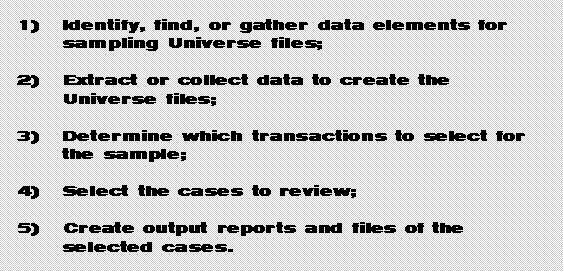
The sampling methodology for nonmonetary determinations contains five distinct steps.
How these five steps are accomplished is the SESA's choice. Not all States have the
same level of automation, and varying file structures may lend themselves to different
sampling approaches.
Step 1 - Gather Data for the Sampling Universe
| Collect Required Data
|
The first step is to gather or have access to THE UNIVERSE (ALL of the particular transactions to be reviewed). It is essential that every transaction or item meeting the criteria be included. This means that all possible sources or locations of the transactions must be searched. For example, since nonmonetary determinations generated in various units such as BPC and BAM (formerly BQC) are included by definition, check to be certain they will all be included in the universe. |
 |
Be sure to check that only valid transactions are
included. Refer to the definitions in the UI Reports Handbook No. 401 to determine which
records should be included.
For instance, determinations which are generated for the sole purpose of establishing
an overpayment amount are not valid in terms of the definitions. The SESA ADP staff is responsible for creating universe files which contain the
requested information. The NO has developed specifications of the minimum data needed for
each sampling universe. The SESA ADP staff is responsible for creating the programs and/or
utilities to extract or gather the requested data elements. Each sample being reviewed will be selected from a universe which includes the nonmonetary determinations which were dated within the three months in the preceding quarter, which is referred to as the review quarter. The date the determination was issued determines which quarter's universe that record will be included. |
 |
HINT: Once the elements for the universe
files have been identified and the extraction program created, the BTQ reviewer should
examine a small cross section of the records to verify that the data elements are correct
and the proper time frames are being followed. After the BTQ reviewer has approved the data elements and time frame, the SESA ADP
staff should establish procedures for building the universe files, selecting the sample
cases and saving the universe files. |
| Schedule Data Capture | In building the universe files, nonmonetary determinations
should be captured as they occur. This is important as the desired transaction may be superseded by a subsequent
transaction and the desired information may no longer be readily available. This may be
especially true in highly automated States where data fields are often overlaid with the
most recent information. Some States may be able to reconstruct events by using daily transaction logs maintained in their data processing environment. It is still better to capture the transactions as they occur during the time period to be reviewed. |
Step 2 - Collect Data to Create the Universe
| Data Collection | The SESA ADP staff should create a program to gather the
data. This program can be written using any computer language or utility such as
Easytrieve, FileAid, or SAS. The NO recommends that the SESA follow the NO file layouts
provided. The resulting transaction files can then be used as input into a sample
selection program such as PICKNMBR.
|
| Save Universe Files | States MUST save the universe files from which samples are selected for data validation purposes for one year. |
Step 3 - Determine Records for the Sample
| Perform Calculations | The third step is to determine which records to select for the sample. The formulas used to determine which records to select must be the formulas provided by the NO, or alternative formulas approved by the NO. |
To perform the calculations, three numbers are needed:
1. Total Records in the Universe - Once the universe has been created, a count of all the transactions in the universe must be performed. This count is represented by "P" in the calculations.
2. Number of Records to Sample. The number of cases to sample for nonmonetary determinations depends on the total number of nonmonetary determinations reported by the State in the preceding calendar year. States reporting 100,000 or more nonmonetary determinations will sample 50 separation issues and 50 nonseparation issues each quarter for quality review. States reporting fewer than 100,000 determinations in the preceding calendar year will sample 30 separation issues and 30 nonseparation issues each quarter for quality review. States may sample larger numbers if they choose, but all of the determinations sampled must be reviewed and entered into the database in order to preserve the validity of the sample. Before running the sampling routine, the universe of nonmonetary determinations must be sorted by separation issues and nonseparation issues so that an independent sample can be drawn from each.
Reference to ETA 9052. For quarterly samples selected from the nonmonetary transactions files beginning in the first quarter of CY 1998, the total nonmonetary determinations reported in the ETA 9052, Nonmonetary Determinations Time Lapse, reports for CY 1997 will be used to determine the State sample sizes.
3. Random Number. This is the third critical number necessary to perform the sample calculations. It is represented as "R" in the formulas. Random numbers may be obtained from any statistics manual.
FORMULAS TO IDENTIFY RECORDS FOR QUALITY SAMPLES
The following are the steps needed to determine which records to select for the sample.
These steps must be repeated for each sample that will be selected.
After the above mentioned numbers are identified, several calculations must be
performed.
CALCULATIONS
First, determine the sampling interval (K), by dividing the sample size into the
universe size. If the result of this calculation is not a whole number, round the result
to the nearest integer.
K = P/N (round to the nearest integer)
Second, determine the starting point (I) within the universe. This is accomplished by
multiplying the sampling interval (K) by the random number (R) and rounding to the nearest
integer.
I = (R*K) (round to the nearest integer)
Next, "N" cases must be selected. This is accomplished by selecting pairs of
cases (J) until all the cases have been identified. First, the number of pairs must be
determined by:
If N is even, J = 0, 1, 2, ... (1/2N - 1)
If N is odd, J = 0, 1, 2, ... 1/2(N - 1) - 1, the remaining case is calculated separately.
Once the number of pairs is determined, the cases are selected by using the following
formulas:
I + JK and (P - JK) - I + 1
The remaining (odd) case is calculated by:
I + 1/2(N - 1)K
Alternatively, the cases can be selected systematically beginning with the starting
point, I; subsequent cases will be selected by I + JK, with J = 1, 2, . . ., (N-1).
CALCULATIONS
For example if: P = 43, N = 5, R = .261
K = 43/5 = 8.6 = 9
I = (.261 * 9) = 2.349 = 2 (rounded)
Since N = 5,
J = 1/2(5 - 1) - 1 = 1
The following records would be selected:
I + JK (P - JK) - I + 1
when J = 0 2 + (0*9) = 2 (43 - 0*9) - 2 + 1 = 42
when J = 1 2 + (1*9) = 11 (43 - 1*9) - 2 + 1 = 33
the remaining case is calculated by: I + 1/2(N - 1)K
2 + 1/2(5 - 1)9 = 20
Records 2, 11, 20, 33, and 42 would be selected for the sample.
If: P = 244, N = 10, R = .743
K = 244/10 = 24.4 = 24
I = (.743 * 24) = 17.832 = 18 (rounded)
The following records would be selected:
18, 227, 42, 203, 66, 179, 90, 155, 114, and 131. (Put in order, low to high.)
| Other Automated Approach (e.g. Easytrieve) |
The SESA may choose to use another automated method of identifying which records will constitute the sample. However, it is imperative that the formulas described on pages A-5 and A-6 may be used to ensure that the sample selection is non-biased. |
Steps 4 & 5 - Select Cases and Create Sample Files
The last steps of the sampling process involve the creation of files containing the
selected sample cases. These steps use the universe file from step two and the calculated
record numbers from step three to create the sample file. The calculated record numbers
from step three identify which records from the universe file will comprise this file.
The sample case file must contain, at a minimum, the skeleton fields identified in ET Handbook 402, 3rd Edition, Change 2, plus the claimant's social security number.
The PICKNMBR program can be used for every sample process. The
calculations performed by this program are designed to ensure a non-biased systematic
sample. This program is not dependent on the method used to select the sample cases.
Appendix A of Change 7 to ET Handbook 401 references two programs which were developed
by the Department for the Tax Performance System (TPS) samples: PICKNMBR and SAMPS0nn. The
TPS SAMPSOnn programs, specifically the TPS Status Determination sample selection program,
can serve as a general model for the development of a sample selection program specific to
the Benefits Quality program. It would require extensive modifications for use in
selecting nonmonetary determinations or lower authority appeals samples. States are
discouraged from undertaking this task.
States are reminded that, as stated in Change 7 to ET Handbook 401, "States are
responsible for creating the programs/utilities necessary to extract the data elements for
the universe files for each [benefit quality] sample." The Department cannot provide
programming resources to write or modify sample selection routines.
The PICKNMBR program can be used if the Universe is:
Detailed descriptions of PICKNMBR and of the National Office COBOL sampling
programs are provided in ET Handbook 401, Appendix A.